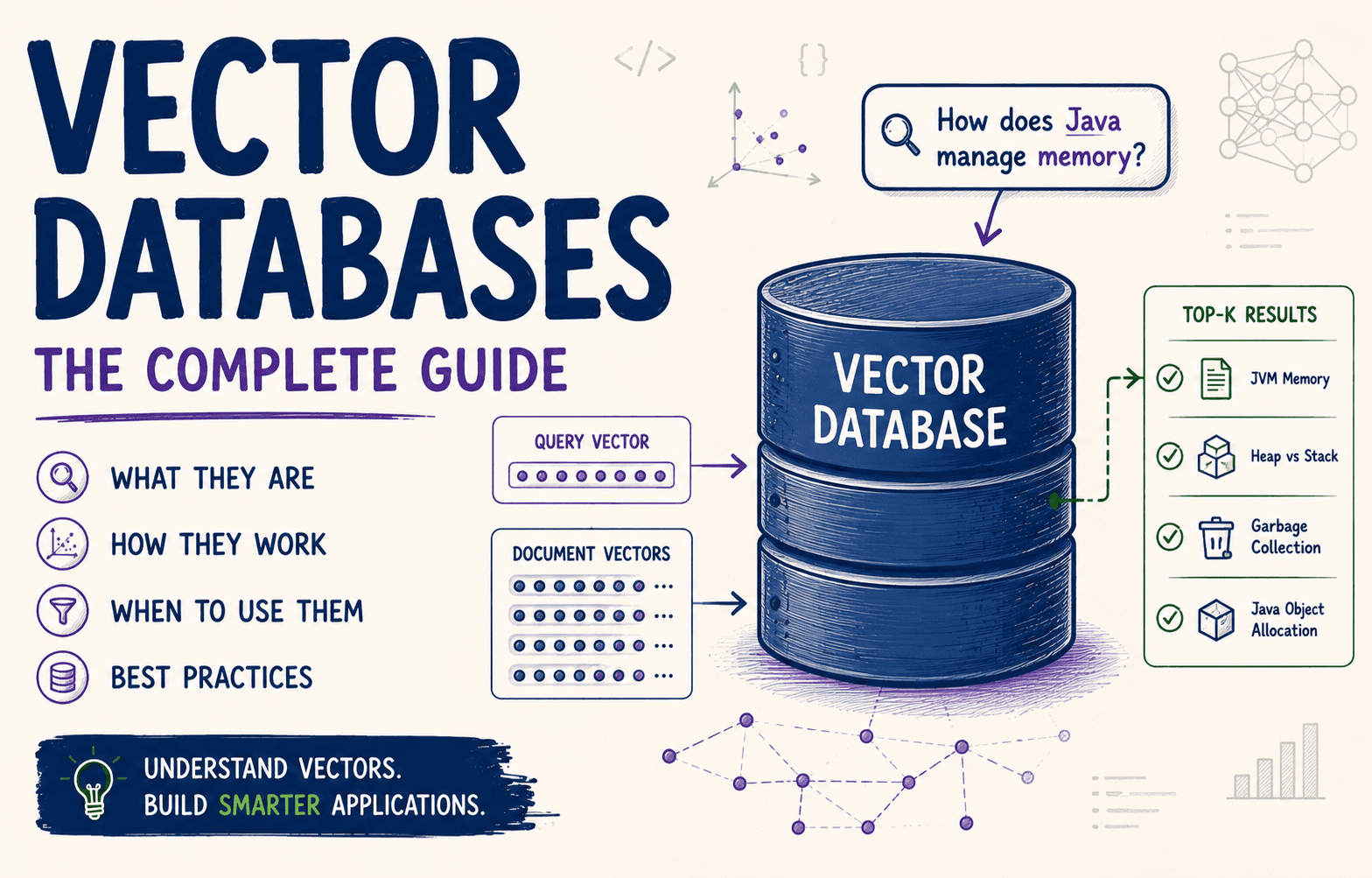
What Is a Vector Database and When Should You Use One?
Vector databases have become extremely popular with the rise of AI applications, RAG systems, semantic search, and recommendation systems.
Because of that popularity, it is easy to think:
“If I am building an AI application, I probably need a vector database.”
But that is not always true.
Before choosing a vector database, there is a more important question:
What kind of search problem am I trying to solve?
A vector database is useful when your application needs to search data based on similarity, rather than only exact values or exact words.
Let's understand why.
1. Traditional Search vs Similarity Search
Imagine your system contains this article:
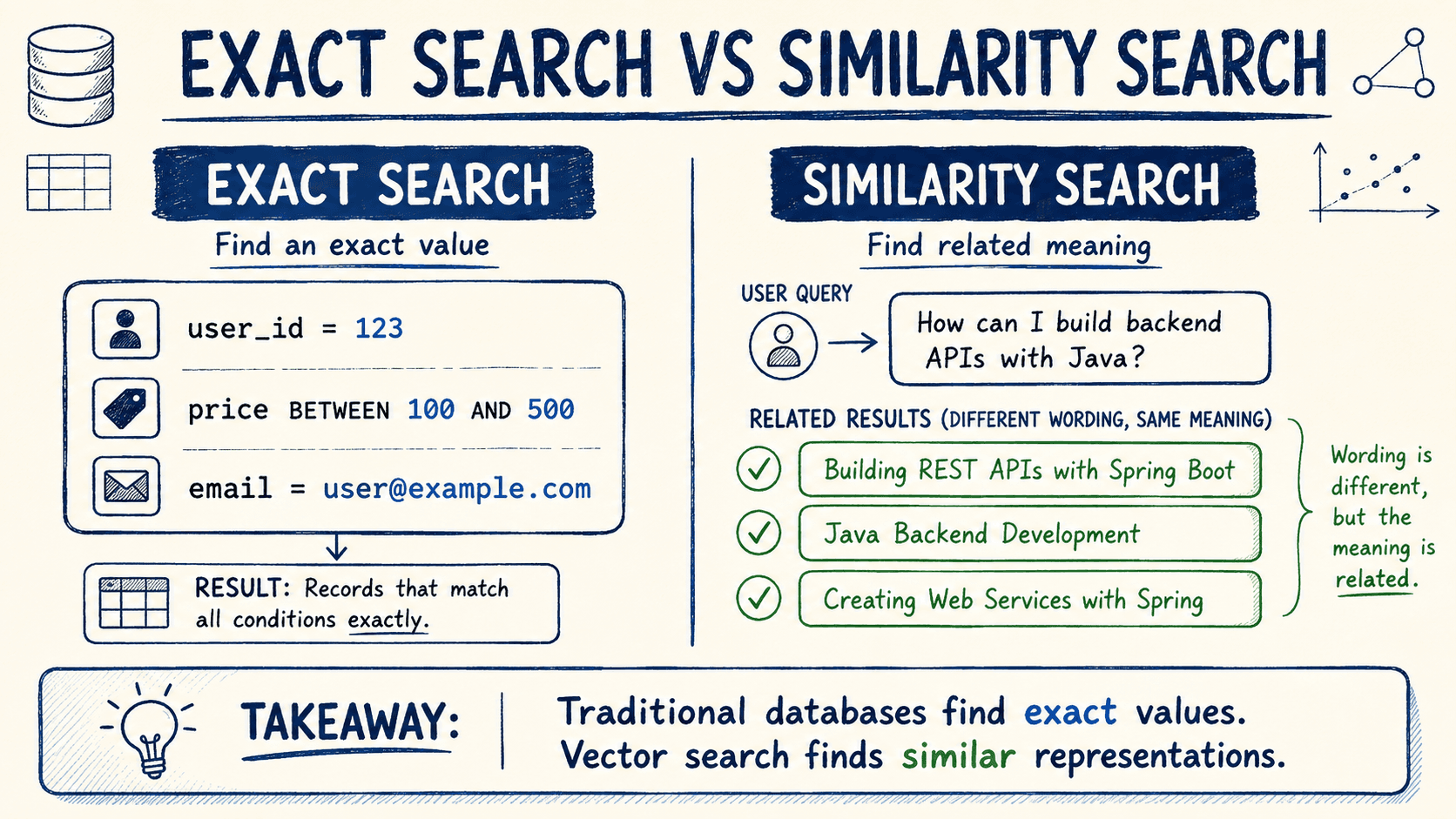
“Building REST APIs with Spring Boot”
A user searches for:
“How can I create backend APIs with Java?”
The two sentences do not contain exactly the same words.
But they are clearly related.
A traditional SQL query is excellent when you know exactly what you are searching for.
For example:
SELECT *
FROM users
WHERE id = 123;
Or:
SELECT *
FROM products
WHERE price BETWEEN 100 AND 500;
These are exact conditions.
But semantic search asks a different question:
Which piece of data is most similar to what the user is asking about?
That is where vector search becomes useful.
2. What Is a Vector Database?
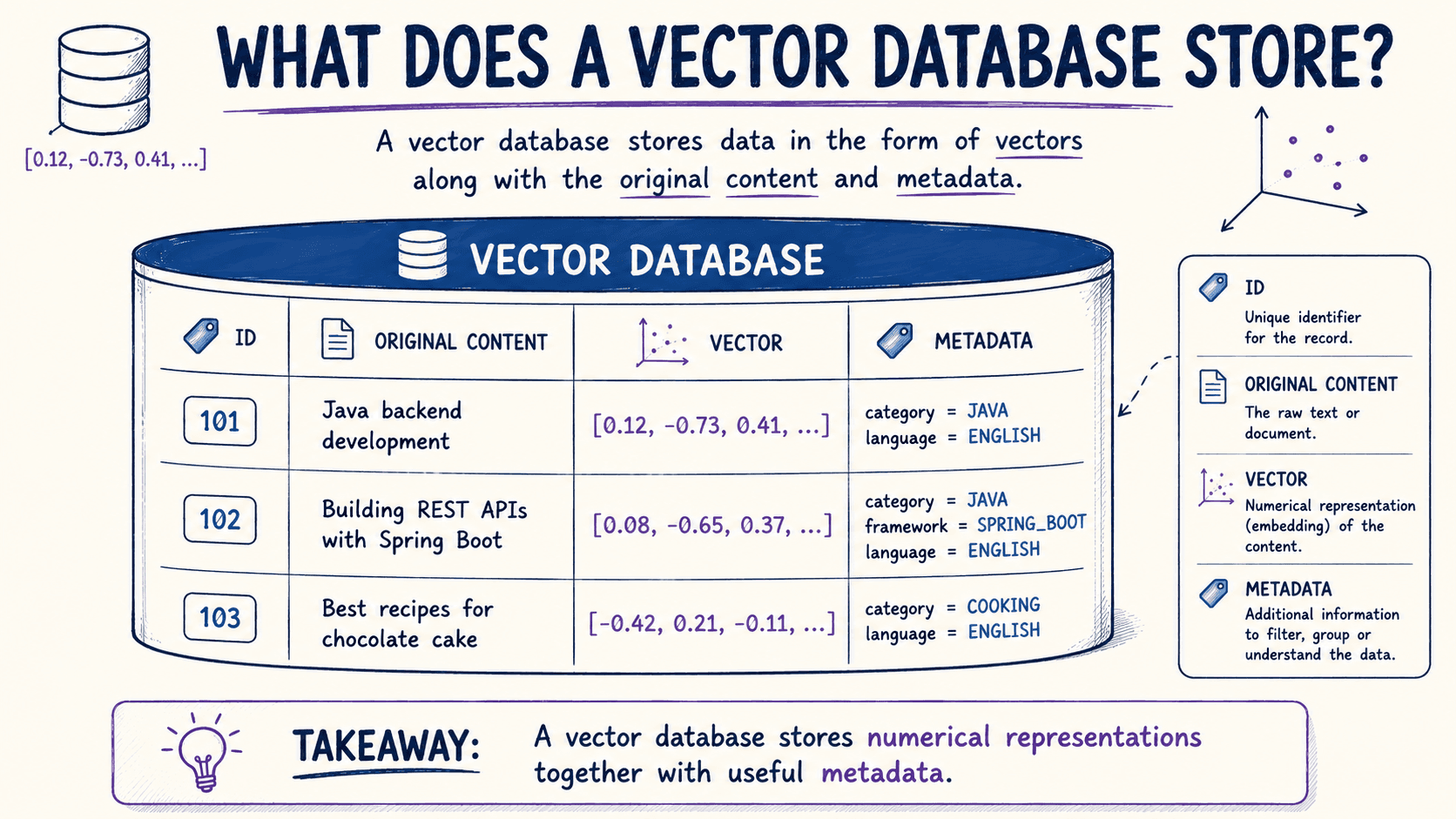
A vector database is a database designed to store and search vector representations efficiently.
A vector may look like this:
[0.12, -0.73, 0.41, 0.28, ...]
These vectors are usually generated by an embedding model.
For example, your application could take:
“Java backend development”
generate a vector for it, and store that vector in a vector database.
The database might conceptually store:
ID: 101

Content:
“Java backend development”

Vector:
[0.12, -0.73, 0.41, ...]

Metadata:
category = JAVA
language = ENGLISH
Now imagine thousands or millions of documents stored this way.
When the user searches for something, their query is also converted into a vector.
The vector database then searches for stored vectors that are closest to the query vector.
That process is called similarity search.
3. Why Do We Need a Special Database for Vectors?
You might now ask:
“Why can't I just store the vector in PostgreSQL or another database?”
For small datasets, you often can.
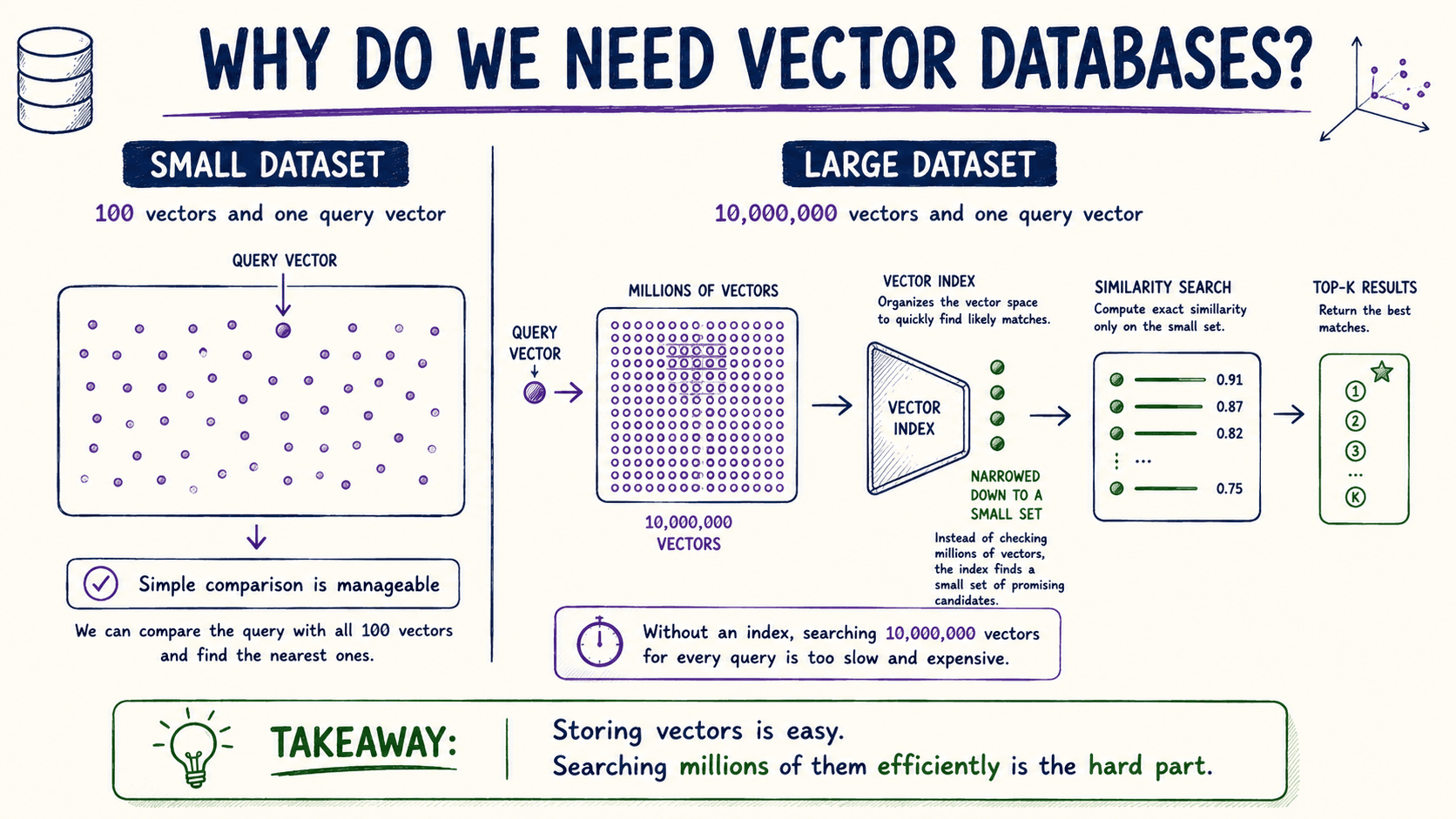
Suppose you have only 100 vectors.
Comparing a query against those vectors is relatively easy.
But imagine your application contains:
10,000,000 vectors
Now every search might require comparing the query with millions of vectors.
Doing that repeatedly can become expensive.
This is one of the main reasons vector databases and specialized vector indexes exist.
They are designed to efficiently answer questions like:
“Which 10 vectors are closest to this query vector?”
Instead of treating every search as a full scan of the entire dataset, vector search engines can use specialized indexing techniques to reduce the search space.
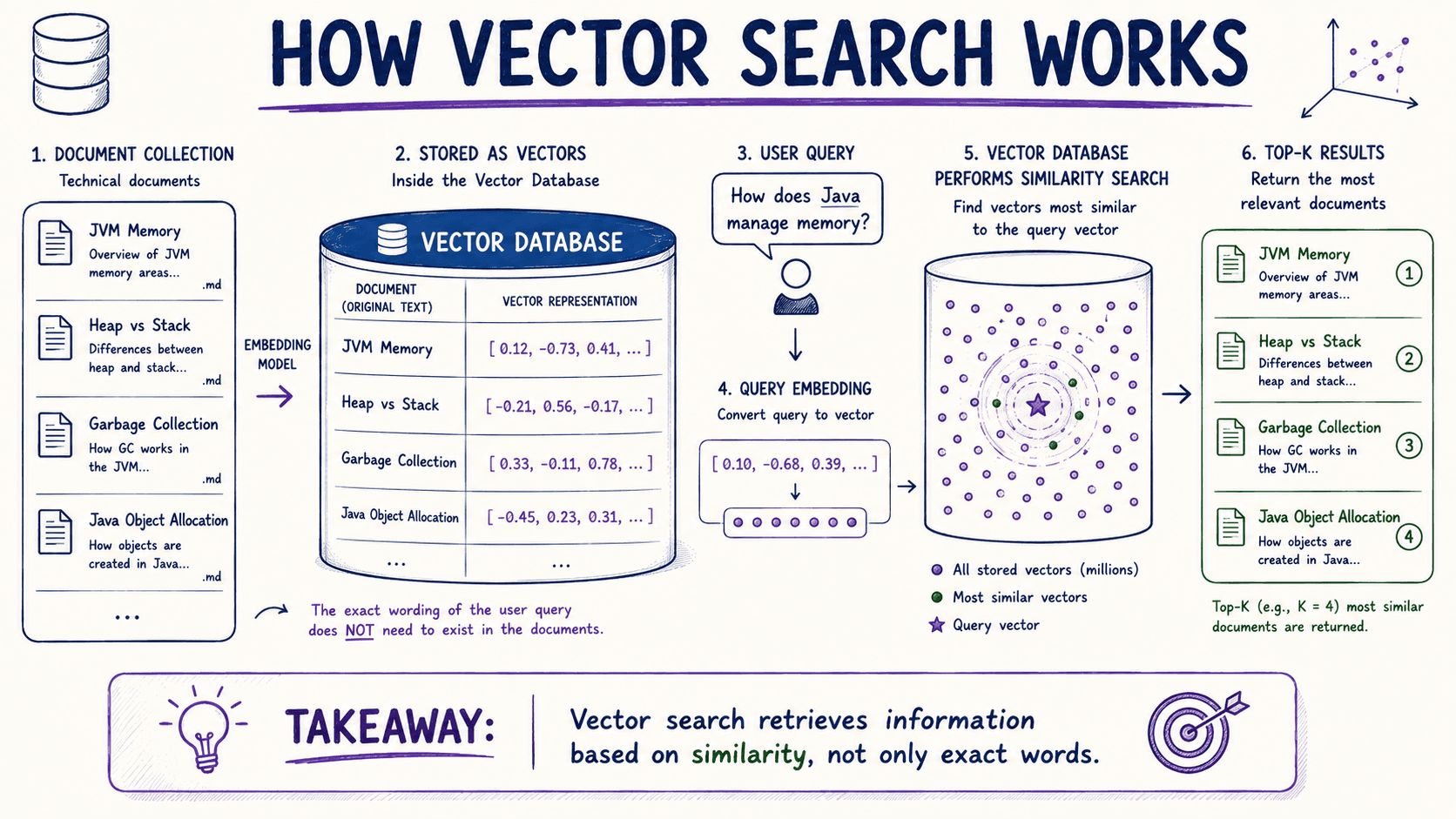
4. How Does Vector Search Work?
The high-level process is simple.
Suppose you have thousands of technical articles.
First, your application generates embeddings for those articles and stores them in the vector database.
Later, a user searches:
“How does Java manage memory?”
The application creates a vector representation of that query.
The vector database compares that query representation with the stored vectors and returns the most similar results.
Those results might include documents about:
- JVM memory,
- heap and stack,
- garbage collection,
- Java object allocation.
The exact sentence “How does Java manage memory?” does not have to exist in the database.
The system searches based on similarity.
5. What Does Top-K Mean?
You will often see something like:
topK = 5
in vector search APIs.
It simply means:
Return the five closest results.
For example, a search for:
“Java backend framework”
could produce:
1. Spring Boot Framework
2. Building REST APIs with Java
3. Java Backend Architecture
4. Spring MVC Guide
5. Java Microservices
The database does not need to return every possible match.
It returns the most relevant candidates.
This is especially useful in applications such as semantic search and RAG.
6. Vector Search and Metadata Filtering
Similarity is not always enough.
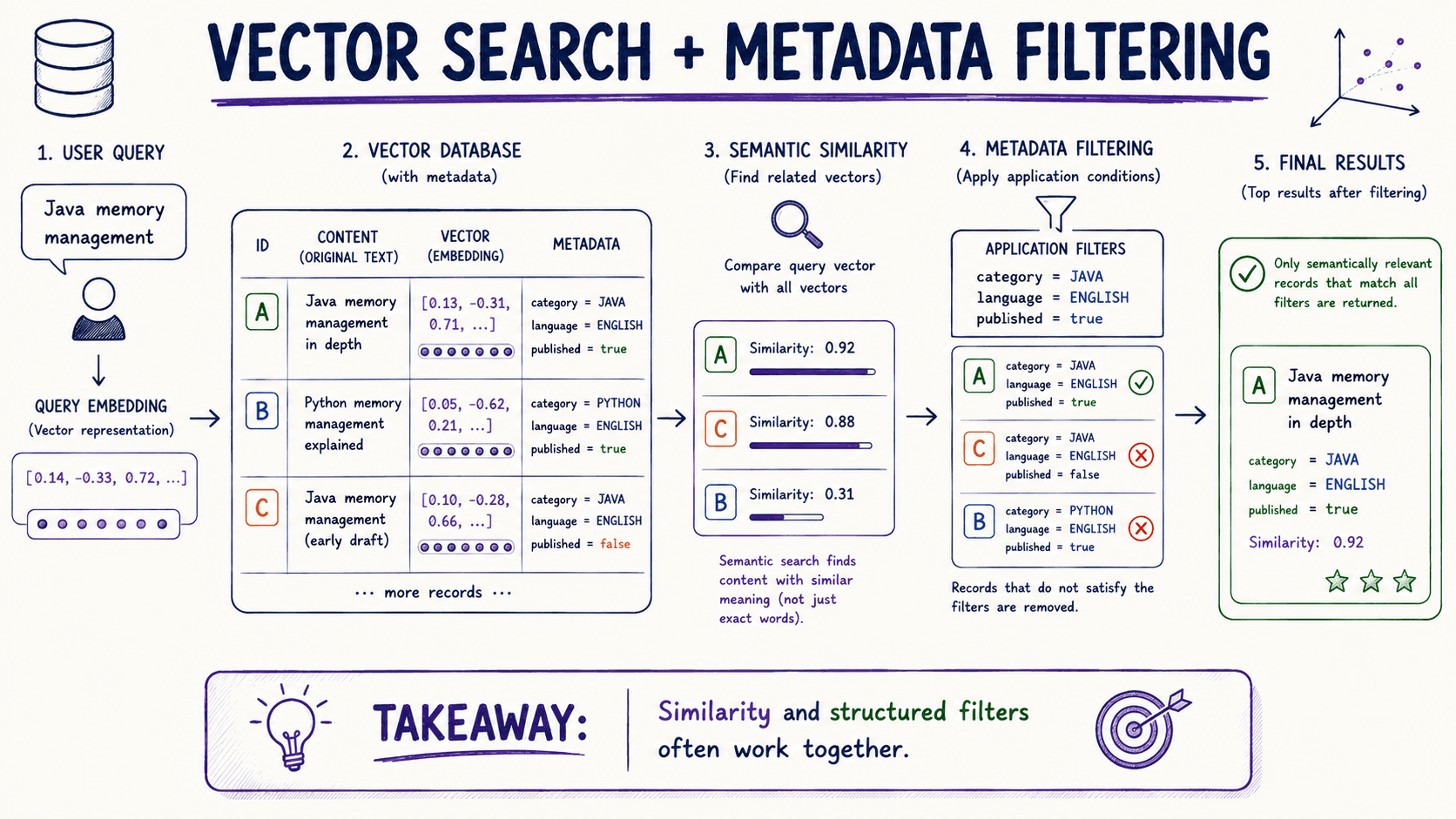
Imagine your application contains articles in many categories and languages.
A user searches:
“Java memory management”
But you only want:
category = JAVA
language = ENGLISH
published = true
A vector database can often combine:
vector similarity
with:
metadata filtering
A stored record might conceptually contain:
Content:
“Understanding JVM Heap Memory”Vector:
[0.21, -0.42, 0.78, ...]
Metadata:
category = JAVA
language = ENGLISH
published = true
The system can first apply your business filters and then retrieve relevant vectors.
This is important because real-world search is rarely based on semantic similarity alone.
7. When Should You Use a Vector Database?
This is the most important part.
You should consider vector search when similarity is part of the problem you are solving.
Here are some common examples.
Semantic Search
Users do not know the exact terminology contained in your data.
For example:
“How can I prevent duplicate payment requests?”
could retrieve:
“Implementing Idempotency in Payment APIs”
The words are different, but the concepts are related.
RAG Applications
You have documents, PDFs, company knowledge, documentation, or other private information.
Before sending a question to an LLM, you need to retrieve the most relevant pieces of information.
Vector search is commonly used for this retrieval step.
Similar Product Search
Imagine an e-commerce application.
A user is viewing:
“Lightweight waterproof hiking shoes”
You want to retrieve products with similar characteristics.
Vector representations can help with this type of similarity search.
Recommendation Systems
Vectors can be used as part of systems that retrieve similar:
- products,
- articles,
- movies,
- users,
- songs,
- or other content.
Image Similarity
Images can also be represented as vectors.
A system can search for images that are visually or semantically similar to another image.
Duplicate or Similar Content Detection
Two texts may communicate almost the same thing even if they are written differently.
Vector similarity can help identify these near-duplicates.
8. When Should You NOT Use a Vector Database?
Do not use a vector database simply because your application includes AI.
If your problem is:
WHERE user_id = 123
you probably need a normal database index.
If you need:
WHERE email = 'user@example.com'
you do not need vector similarity.
If you need:
WHERE price BETWEEN 100 AND 500
a relational database already solves this extremely well.
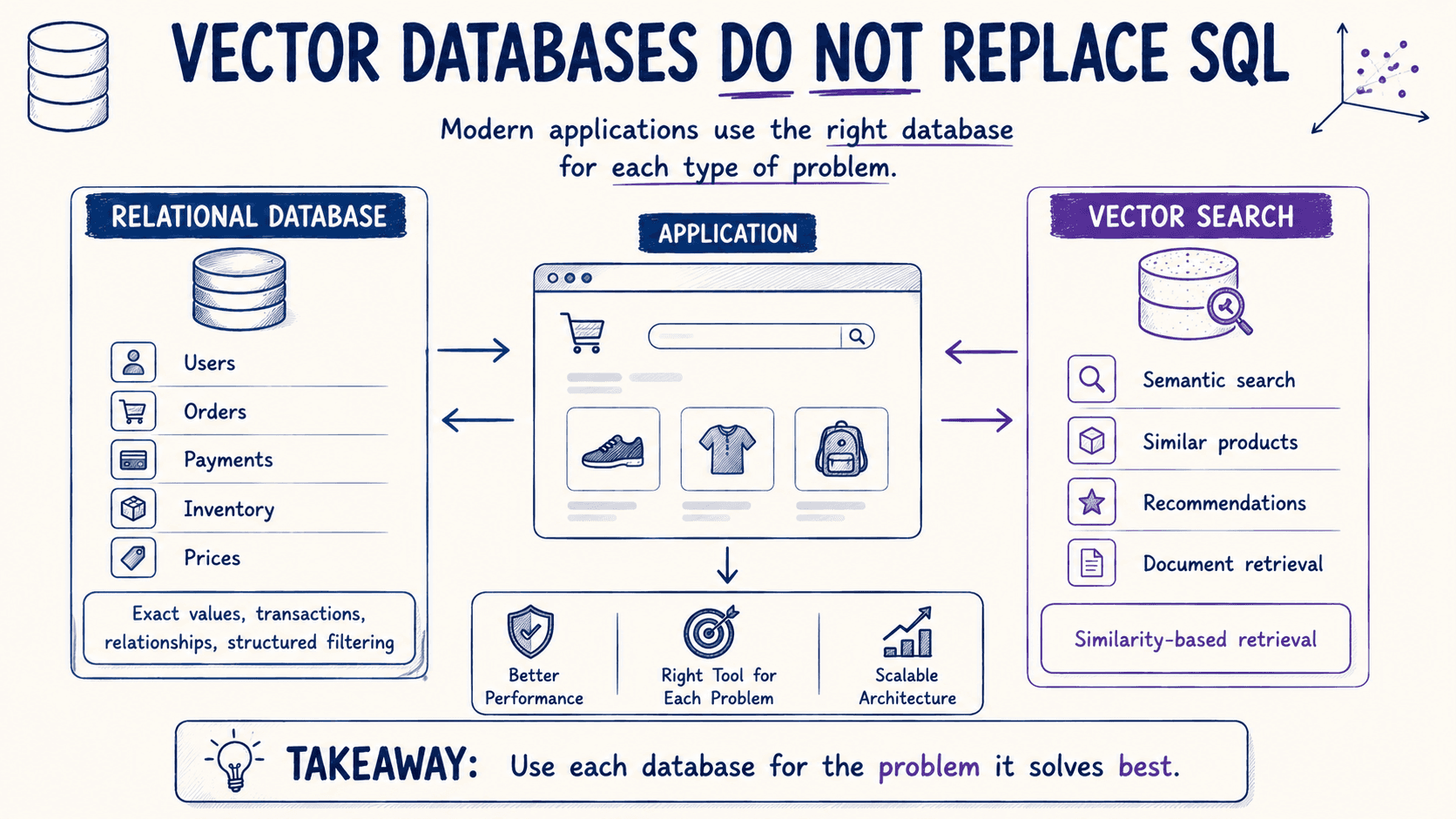
Vector databases are also not natural replacements for systems centered around:
- payments,
- orders,
- account balances,
- inventory,
- transactions,
- strict relationships,
- foreign keys,
- transactional consistency.
For those problems, relational databases such as PostgreSQL are usually a much better core database.
Vector search can still exist beside them.
9. SQL, Full-Text Search, or Vector Search?
A simple way to decide is to ask:
What exactly am I trying to find?
Requirement
Good Starting Point
Find user with id = 123
SQL
Filter products by price
SQL
Find articles containing “Spring Boot”
Full-Text Search
Find articles related to “How do I build Java APIs?”
Vector Search
Find similar products
Vector Search
Retrieve relevant documents for RAG
Vector Search
Semantic search with category filters
Vector Search + Metadata Filtering
Real applications can also combine these approaches.
For example, you might use semantic similarity together with keyword search and metadata filtering.
This is commonly called hybrid search.
10. Do I Actually Need a Vector Database?
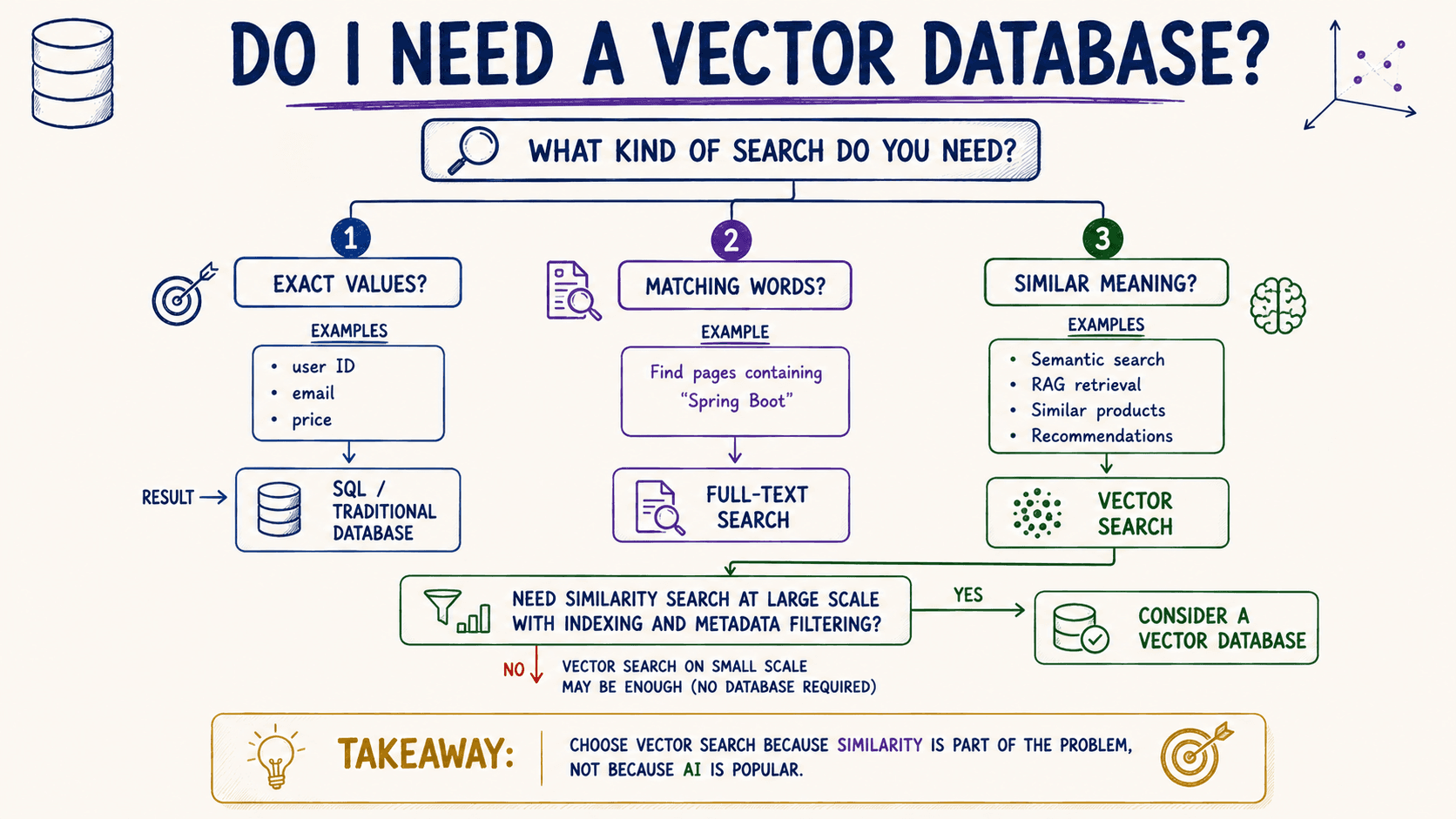
Before adding a vector database to your architecture, ask yourself three questions.
Am I searching for exact values?
Use a traditional database.
Am I mainly searching for words that appear in the document?
Full-text search may be enough.
Do I need to find information that is similar in meaning even when the words are different?
Now vector search becomes interesting.
And if you need that similarity search across a large collection of vectors with fast retrieval, filtering, and indexing, a vector database or a database with vector-search capabilities may be a good choice.
Final Takeaway
A vector database is not a magical AI database.
Its main purpose is much simpler:
Store and efficiently search vector representations based on similarity.
Traditional databases are excellent when you know exactly what you are looking for.
Vector search becomes useful when the question changes from:
“Which record matches this value?”
to:
“Which data is most similar to what the user means?”
That is the key distinction.
Use vector search for problems such as semantic search, RAG retrieval, similar products, recommendations, and similarity detection.
Use traditional databases for structured data, transactions, exact filters, relationships, and business records.
In many real systems, you will use both.
The important thing is not choosing the newest technology.
It is choosing the right technology for the problem.
Follow My Content
If you enjoy content about Java, backend engineering, concurrency, computer architecture, and system design, you can follow my work on:
- Instagram: @the.code.architect
- Medium: medium.com/@sarvar55mszde
- LinkedIn: Follow me here for technical discussions, software engineering lessons, and new articles from this series.
Comments (0)
Loading comments...